


TL;DR verdict
Clerk is the faster starter-kit default when the product still needs polished sign-up, user profiles, organizations, and Next.js middleware before it needs enterprise procurement workflows. WorkOS is the stronger enterprise-readiness layer when the buyer already expects SAML/OIDC SSO, Directory Sync, customer-owned admin configuration, and IT-admin onboarding and setup.
For most B2B SaaS boilerplates, the safest implementation decision is not "Clerk or WorkOS forever." It is: launch with the provider that matches the first paid customer, keep tenant and entitlement code inside your app, and leave a clean seam for SSO, provisioning, and admin support when enterprise customers arrive.
This is the implementation and deployment-readiness page in the StarterPick auth cluster. Use the broader Clerk vs Auth0 vs WorkOS comparison when you need market positioning; use this guide when you need to decide what code, webhooks, tests, and launch checks belong in a SaaS starter.
Prices and plan names change. Treat pricing references here as source checks retrieved on 2026-08-27, then verify Clerk and WorkOS pricing pages before you set a launch plan or promise enterprise features to a customer.
Key Takeaways
- Pick Clerk first when your starter needs excellent Next.js auth DX, organization switching, user/profile UI, protected route middleware, and a low-friction path to an MVP.
- Pick WorkOS first when SSO, directory provisioning, customer admin setup, and enterprise rollout are must-have requirements for the first contract.
- Do not treat either provider as a billing system. Auth events can trigger billing workflows, but your app still owns seats, entitlements, subscriptions, invoice state, and cancellation behavior.
- Model organizations, roles, and billing in your own database even if the auth provider stores user and organization records. That keeps product policy portable.
- The hardest production bugs are rarely the sign-in screen. They are org switching, stale role claims, webhook retries, deprovisioned users, preview/prod env drift, and billing-seat reconciliation.
- Keep this page distinct from generic auth comparisons: it is about what a SaaS boilerplate must implement before it is safe to sell as B2B-ready.
At-a-glance implementation table
| Implementation question | Clerk-first answer | WorkOS-first answer | StarterPick recommendation |
|---|---|---|---|
| Fastest credible MVP | Strong. Use prebuilt auth UI, user/profile flows, organizations, and Next.js middleware. | Possible with AuthKit, but the enterprise feature set may be more than an MVP needs. | Use Clerk if SSO is not committed revenue. |
| Enterprise SSO on day one | Available depending on plan and configuration, but evaluate cost and org policy carefully. | Core WorkOS lane: SAML/OIDC SSO plus customer setup patterns. | Use WorkOS when the launch contract names SSO or procurement review. |
| SCIM / Directory Sync | Not the default reason to choose Clerk for a starter-kit implementation. | Core WorkOS lane for provisioning and deprovisioning workflows. | Use WorkOS when lifecycle automation is a sales requirement. |
| Next.js protected routes | clerkMiddleware() integrates authentication, while authorization stays close to each data resource. | WorkOS AuthKit can protect an app, but route policy still lives in your code. | Test resource-level authorization either way; do not rely on middleware alone. |
| Billing integration | Requires app-owned billing, webhook, and entitlement code. | Requires app-owned billing, webhook, and entitlement code. | Keep billing independent from auth-provider records. |
| Customer admin setup | App-owned org settings plus Clerk organization UI can be enough early. | Admin Portal can reduce internal support for enterprise setup. | Treat Admin Portal as support surface, not just a login feature. |
| Exit path | Easier if your app owns tenant IDs, roles, and entitlements. | Easier if WorkOS remains an enterprise identity seam rather than the only product model. | Store provider IDs as adapters, not as your domain model. |
Evidence cards
Clerk evidence card
Clerk's current documentation positions Organizations as a way to build multi-tenant B2B applications with team workspaces and role-based access control, and its Next.js middleware reference integrates authentication at the framework layer while directing applications to enforce authorization close to each resource. That combination is why Clerk remains the easier default for a boilerplate that wants a polished auth surface before it has enterprise identity requirements.
Implementation read: Clerk reduces sign-up, user-management, organization-switching, and protected-route setup time. It does not remove the need to review tenant authorization, billing entitlements, webhook idempotency, or plan limits before launch.
WorkOS evidence card
WorkOS documentation centers AuthKit plus enterprise primitives such as Single Sign-On, Directory Sync, and Admin Portal. Those are the requirements that turn a normal team-login starter into an enterprise-ready B2B starter: customer-managed SAML/OIDC setup, automated provisioning and deprovisioning, and less manual support during rollout.
Implementation read: WorkOS is strongest when your buyer already expects IT-admin workflows. It can be overkill for an indie MVP, but under-building this layer is expensive when a procurement team asks for SSO and SCIM before signing.
Pricing and freshness evidence card
The Clerk and WorkOS pricing pages were checked on 2026-08-27 because auth/security and pricing claims age quickly. Do not hard-code a starter-kit recommendation around a historical monthly price, free allowance, per-connection charge, or add-on threshold. Verify the current page, then model the first three customer stages: launch, first SSO customer, and ten-plus enterprise customers.
Production readiness score
| Dimension | Clerk-first starter | WorkOS-first starter | What earns a production-ready score |
|---|---|---|---|
| Time to safe MVP auth | 9/10 | 7/10 | Sign-up, sign-in, user profile, org creation, protected routes, and preview/prod env setup are documented and tested. |
| Enterprise SSO readiness | 6/10 | 9/10 | SAML/OIDC setup, customer admin ownership, callback handling, and support playbooks are real, not TODOs. |
| Directory provisioning readiness | 4/10 | 9/10 | SCIM/Directory Sync events map to app users, roles, seat state, and deprovisioning behavior. |
| Billing/auth separation | 7/10 | 7/10 | Auth provider IDs are stored as external references; subscription and entitlement truth stays in app-owned billing tables. |
| Debuggability | 8/10 | 7/10 | Middleware decisions, session claims, webhook receipts, and tenant membership changes are logged without leaking secrets. |
| Exit path | 7/10 | 7/10 | The product domain uses app tenant IDs and role policy, not provider-specific identifiers everywhere. |
A starter is not production-ready just because a sign-in button works. It is production-ready when a deprovisioned enterprise user loses access, a plan downgrade removes paid entitlements, a webhook retry does not double-count seats, and an on-call engineer can understand the event trail.
Launch stack table
| Launch layer | Clerk-first stack | WorkOS-first stack | Required implementation check |
|---|---|---|---|
| Identity UI | Clerk sign-in, sign-up, user profile, organization switcher where appropriate | AuthKit-hosted login or app-owned WorkOS flow | Confirm all public, private, and callback routes render in preview and production. |
| Tenant model | App tenant table linked to Clerk organization IDs | App tenant table linked to WorkOS organization/connection IDs | Never use provider IDs as the only tenant domain model. |
| Authorization | Server-side role checks using current session/org context | Server-side role checks after WorkOS authentication and tenant resolution | Test member, admin, owner, suspended, and no-org states. |
| Enterprise SSO | Add only when plan/customer requires it | Build as part of launch if customer contract requires it | Test SSO callback, invite flow, existing-user linking, and fallback admin access. |
| Provisioning | Manual invites or app-owned invites early | Directory Sync / SCIM when customer requires lifecycle automation | Map created, updated, suspended, and deleted users to app state. |
| Billing | Stripe, Polar, Paddle, Lemon Squeezy, or other billing provider in app code | Same | Reconcile subscription owner, org seats, entitlements, webhook retries, and cancellations. |
| Deployment | Next.js middleware, env vars, webhook endpoints, and auth callback URLs per environment | AuthKit/SSO callback URLs, Admin Portal links, env vars, and webhook endpoints per environment | Preview and production must not share secrets, callback hosts, or webhook signing keys. |
| Support | Basic admin/user lookup plus webhook logs | Enterprise setup checklist plus customer-facing Admin Portal handoff | Document who owns customer SSO changes and emergency lockout recovery. |
Billing and auth matrix
| Billing/auth event | What auth provider can tell you | What your billing code must decide | Failure to test |
|---|---|---|---|
| New organization created | A tenant-like organization exists. | Whether it gets a trial, a subscription owner, default limits, and billing metadata. | Free orgs accidentally get paid features. |
| Member invited | A user should join an org. | Whether the invite consumes a paid seat now, on acceptance, or only after activation. | Teams are charged for stale invites or undercharged for accepted ones. |
| Role changed | A user's org role changed. | Which product actions, admin routes, and billing operations that role can perform. | A billing admin keeps access after role downgrade. |
| User deprovisioned | A directory or admin removed access. | Whether to revoke sessions, release a seat, preserve audit history, and notify admins. | Departed employees keep product access or data ownership breaks. |
| SSO connection enabled | Enterprise login is configured. | Whether the customer can enforce SSO-only, domain restrictions, and emergency break-glass access. | Customers lock themselves out or bypass SSO policy. |
| Plan downgraded | Usually nothing unless your app propagates it. | Which entitlements, seats, integrations, and usage limits change immediately. | Auth still allows access to paid enterprise features. |
Do not treat either provider as a billing system. Use auth events as inputs, then make subscription, entitlement, and seat decisions in app-owned code with retries, reconciliation, and audit logs.
Missing pieces to inspect in any boilerplate
Before you buy or standardize on a SaaS starter, inspect these pieces directly. Marketing pages often say "B2B auth" when the repository only contains a happy-path login demo.
- Protected route inventory: dashboard pages, API routes, server actions, admin routes, billing routes, and customer portal routes should all have explicit auth policy.
- Organization invariants: every product record that belongs to a tenant should carry an app-owned tenant ID and should not trust only client-selected organization state.
- Multi-tab organization context: switch organizations in one tab, then verify background requests in each tab use a token for the intended active organization rather than assuming the global session cookie is tab-specific.
- Role policy: roles should be checked server-side, documented, and tested for member/admin/owner edge cases.
- Webhook handling: auth and billing webhooks need signature verification, idempotency keys, retries, dead-letter visibility, and test fixtures.
- SSO rollout: customer domain matching, callback URLs, first-admin bootstrap, break-glass admin access, and logout behavior should be written down.
- Directory Sync: provisioning, deprovisioning, suspended accounts, role mapping, seat release, and reactivation should be tested before enterprise launch.
- Billing reconciliation: plan changes, seat counts, failed payments, canceled subscriptions, trials, and manual comped accounts must not depend on a login provider alone.
- Environment separation: local, preview, staging, and production should use separate callback URLs, webhook secrets, and provider credentials.
Cost to customize
| Customization area | Clerk-first likely effort | WorkOS-first likely effort | Why it matters |
|---|---|---|---|
| Basic auth UI | Low | Medium | Clerk's prebuilt UI usually lowers day-one implementation work; WorkOS/AuthKit still needs product-specific fit and callback setup. |
| Organization permissions | Medium | Medium | Both paths need app-owned role policy, tenant queries, and server-side enforcement. |
| Enterprise SSO | Medium/high if added later | Low/medium if required from day one | Adding SSO after customers exist forces migration, support, and rollout work. |
| SCIM / Directory Sync | High | Medium | Directory lifecycle automation affects billing, seats, and data ownership. |
| Billing hooks | Medium | Medium | Neither provider replaces subscription, seat, entitlement, and webhook reconciliation code. |
| Support tooling | Medium | Medium/high | Enterprise customers need setup status, connection health, audit context, and recovery paths. |
| Migration/exit path | Medium if domain model is clean | Medium if domain model is clean | Provider-specific IDs spread through code raise switching cost. |
The lowest-cost starter is the one whose default auth path you can keep. If you know you will remove half the starter's auth layer, score that as real implementation debt before purchase.
Methodology
This refresh used current primary sources checked on 2026-09-13 for Clerk Organizations, Next.js middleware, webhooks, WorkOS AuthKit, SSO, Directory Sync, Admin Portal, and StarterPick's B2B auth cluster inventory. Clerk and WorkOS pricing remained the separate 2026-08-27 checks shown below. The page intentionally avoids unsupported "saves X weeks" claims and does not rely on private paid boilerplate repositories that were not inspected.
The scoring is implementation-oriented. A high score means the source-backed product surface maps cleanly to boilerplate launch work: protected routes, tenant records, organization roles, SSO setup, provisioning lifecycle, billing reconciliation, deployment configuration, and support operations. It does not mean a provider is universally better.
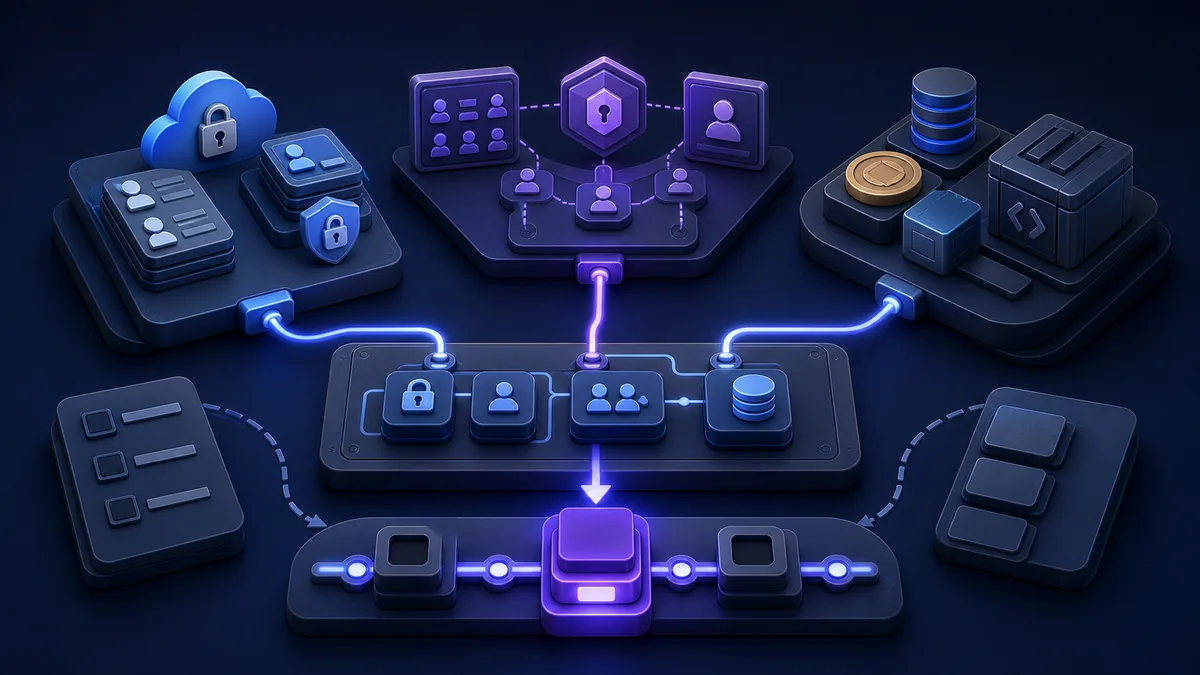
The existing hero image is reused because it shows locks, organization nodes, identity cards, database blocks, and provisioning flow rather than a generic SaaS dashboard. It matches the B2B auth/organization/SSO topic and is already a 1200x675 WebP asset under the guide image path.
Source-backed FAQ
Should a new B2B SaaS boilerplate start with Clerk or WorkOS?
Start with Clerk when your first job is a polished MVP with sign-up, user profiles, organizations, protected routes, and normal team management. Start with WorkOS when SSO, Directory Sync, Admin Portal setup, and enterprise IT review are committed launch requirements. If those requirements are future possibilities, design your tenant and billing model so WorkOS can be added without rewriting the product domain.
Can Clerk handle B2B organizations?
Yes, Clerk's organization documentation is explicitly about multi-tenant B2B applications, team workspaces, and role-based access control. The implementation question is whether the starter kit uses those primitives safely: server-side role checks, tenant-scoped queries, billing ownership, and route protection.
Is WorkOS a replacement for all app authorization?
No. WorkOS can provide enterprise identity and provisioning primitives, but your SaaS still owns product authorization: which tenant can see which record, which role can change billing, and what happens after a directory removes a user. Treat WorkOS as an identity and enterprise-readiness seam, not a replacement for product policy.
What should I test before selling SSO?
Test SSO setup, callback handling, first admin bootstrap, domain matching, role assignment, emergency non-SSO access, logout behavior, and customer admin handoff. Then test Directory Sync separately: user creation, user updates, suspension, deletion, role mapping, seat release, and billing reconciliation.
What pricing check matters most?
Verify the current Clerk and WorkOS pricing pages immediately before launch or purchase. The risky cost triggers are not just monthly base price; they are organization usage, enterprise SSO connections, directory provisioning, active users, add-ons, support tier, and the engineering time required to customize or migrate later.
Can I use both Clerk and WorkOS?
Sometimes. A staged path can use Clerk for the core app login and organizations while adding WorkOS for enterprise SSO or provisioning when a customer requires it. That only stays sane if your app owns tenant IDs, roles, subscriptions, and entitlements instead of scattering provider-specific assumptions through every feature.
Related guides
- Clerk vs Auth0 vs WorkOS for B2B SaaS — broader provider comparison and cluster hub.
- Better Auth vs Clerk vs NextAuth — auth-library decision context for teams considering more ownable auth.
- Next.js boilerplate Clerk authentication — Clerk-specific Next.js implementation context.
- WorkOS AuthKit vs Stack Auth vs Keycloak — enterprise SSO and self-hosted alternatives.
- B2B onboarding wizard starter guide — onboarding, invites, imports, and customer activation after auth.
- Usage-based billing guide — billing-meter and entitlement decisions that should stay separate from auth provider records.
- SaaS boilerplate security checklist — route, webhook, secret, and rate-limit review before production.
- Multi-tenancy SaaS boilerplate buyer's guide — tenant modeling and B2B access control beyond login.
Source notes
- Clerk Organizations documentation, retrieved 2026-09-13. Used for organizations, B2B workspace, and RBAC positioning.
- Clerk Next.js middleware reference, retrieved 2026-09-13. Used for protected-route and deployment-readiness discussion.
- Clerk webhooks overview, retrieved 2026-09-13. Used for event and billing-handoff caveats.
- Clerk pricing page, retrieved 2026-08-27. Used only as a freshness-checked pricing source; verify current details before purchase.
- WorkOS AuthKit documentation, retrieved 2026-09-13. Used for WorkOS authentication implementation context.
- WorkOS Single Sign-On documentation, retrieved 2026-09-13. Used for SAML/OIDC SSO readiness.
- WorkOS Directory Sync documentation, retrieved 2026-09-13. Used for SCIM/provisioning and deprovisioning readiness.
- WorkOS Admin Portal documentation, retrieved 2026-09-13. Used for customer-owned enterprise setup and support workflow discussion.
- WorkOS pricing page, retrieved 2026-08-27. Used only as a freshness-checked pricing source; verify current details before purchase.
- StarterPick B2B auth cluster inventory, retrieved 2026-09-13. Used for internal-link and page-role positioning, not as independent proof of vendor capability.